

 Brandon Heukelman
 2026-02-08
Most racers don’t run out of braking power. They lose confidence when the feel starts to change.
As temperatures rise, braking feel drifts. Initial bite changes. Markers move. Pressure at the lever feels different. That loss of consistency is what forces riders to back off, not necessarily a lack of outright braking performance.
At the highest level of racing, MotoGP teams obsess over this exact problem. Brake ducts are no longer designed to cool as much as possible, but to control temperature so braking feel remains predictable.
By combining basic fluid-mechanics principles with how MotoGP brake duct design has evolved in recent years, three practical design rules consistently emerge.
A quick caveat (important)
With larger brake discs permitted for 2025, aggressive brake cooling is less critical than in previous seasons. At the same time, stricter tyre-pressure limits have increased the importance of temperature stability, not only for brakes but also for tyres and overall front-end behaviour.
Brake ducts today matter less for outright cooling and more for consistency. So we’ll look at previous years where good designs were more critical.
Rule 1 — Inlet in clean, stable airflow
Inlet flow quality dominates everything downstream.
If the inlet is fed by low-energy, highly turbulent air, no amount of duct optimisation can recover the lost total pressure. Increasing inlet area in this condition simply increases losses.
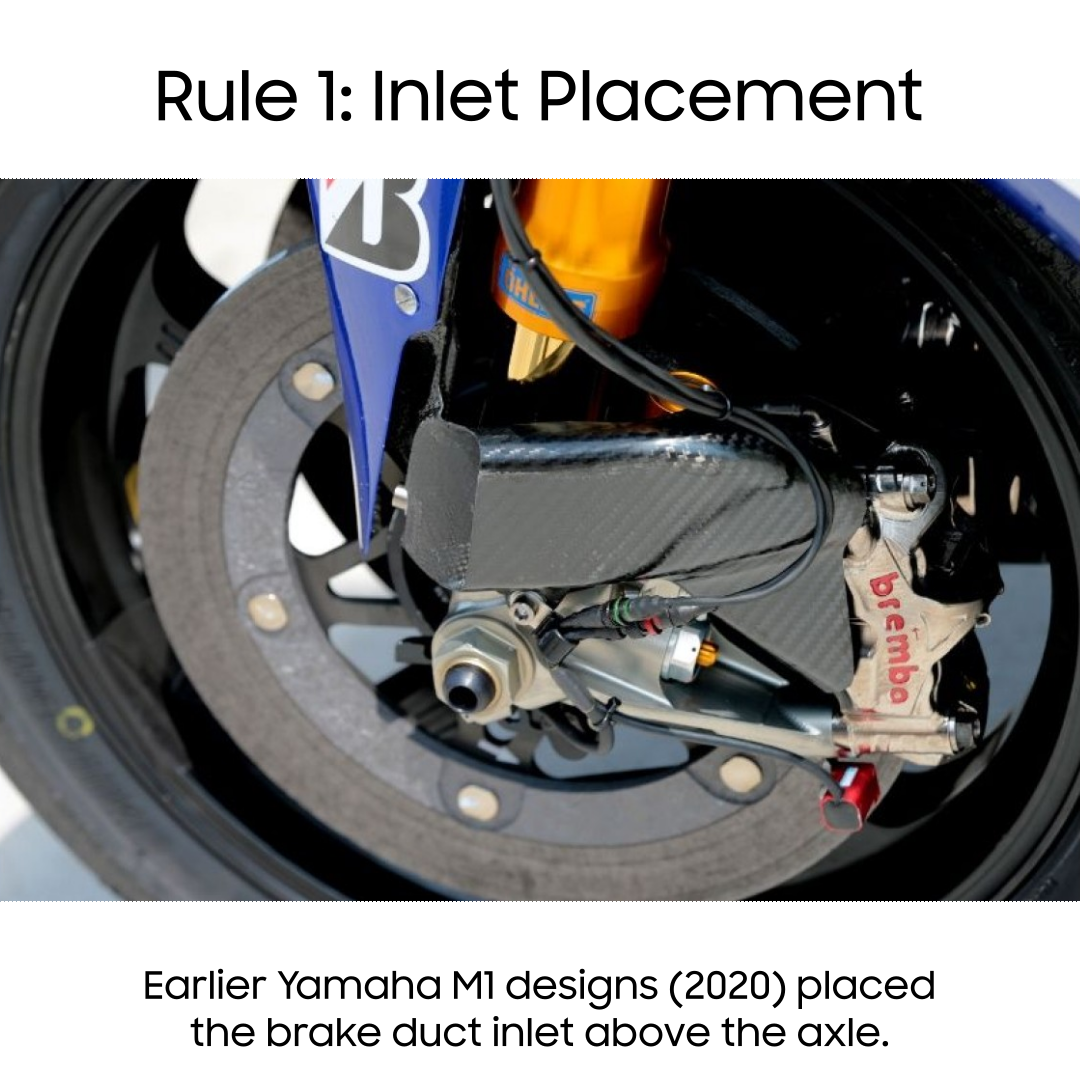
Airflow above the axle is highly turbulent. The rotating tyre moves against the free stream in this region, creating a strong wake and swirl that contaminates the incoming air. The proximity of the fork leg and fender further thickens the boundary layer, reducing usable total pressure at the inlet.
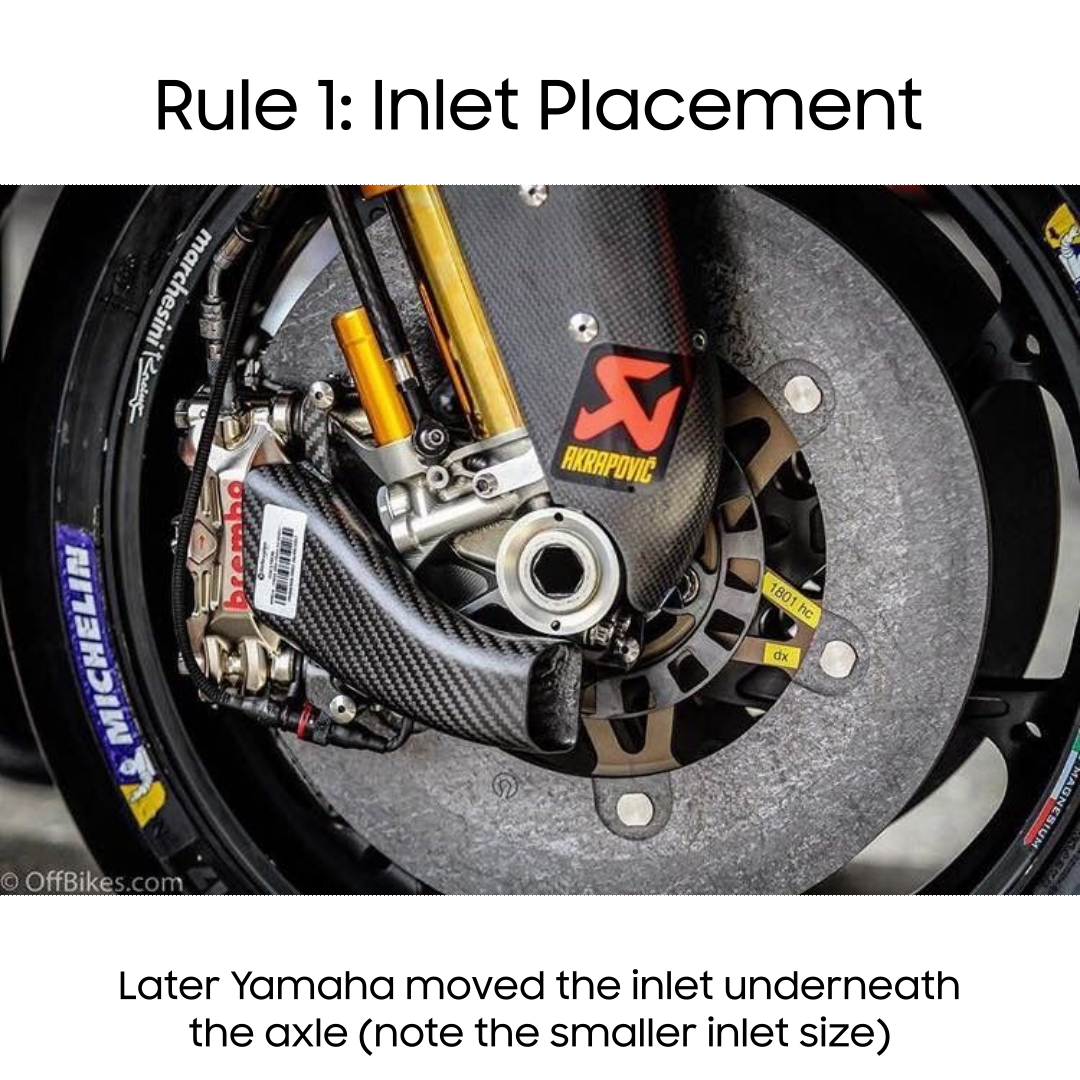
Below the axle, airflow is cleaner and more stable. Placing the inlet below and preferably slightly ahead of the axle reduces tyre-induced swirl and wake interaction, delivering higher usable total pressure into the duct.
Early MotoGP brake ducts were commonly positioned above the axle, such as those seen on the 2020–2021 Yamaha M1. Over time, most teams have migrated to below-axle inlets as the limitations of upper-axle placement became clear.
Rule 2 — Brake duct is a pressure device, not a scoop
Brake cooling is governed by mass flow, and mass flow is sustained by pressure differential, not peak inlet velocity.
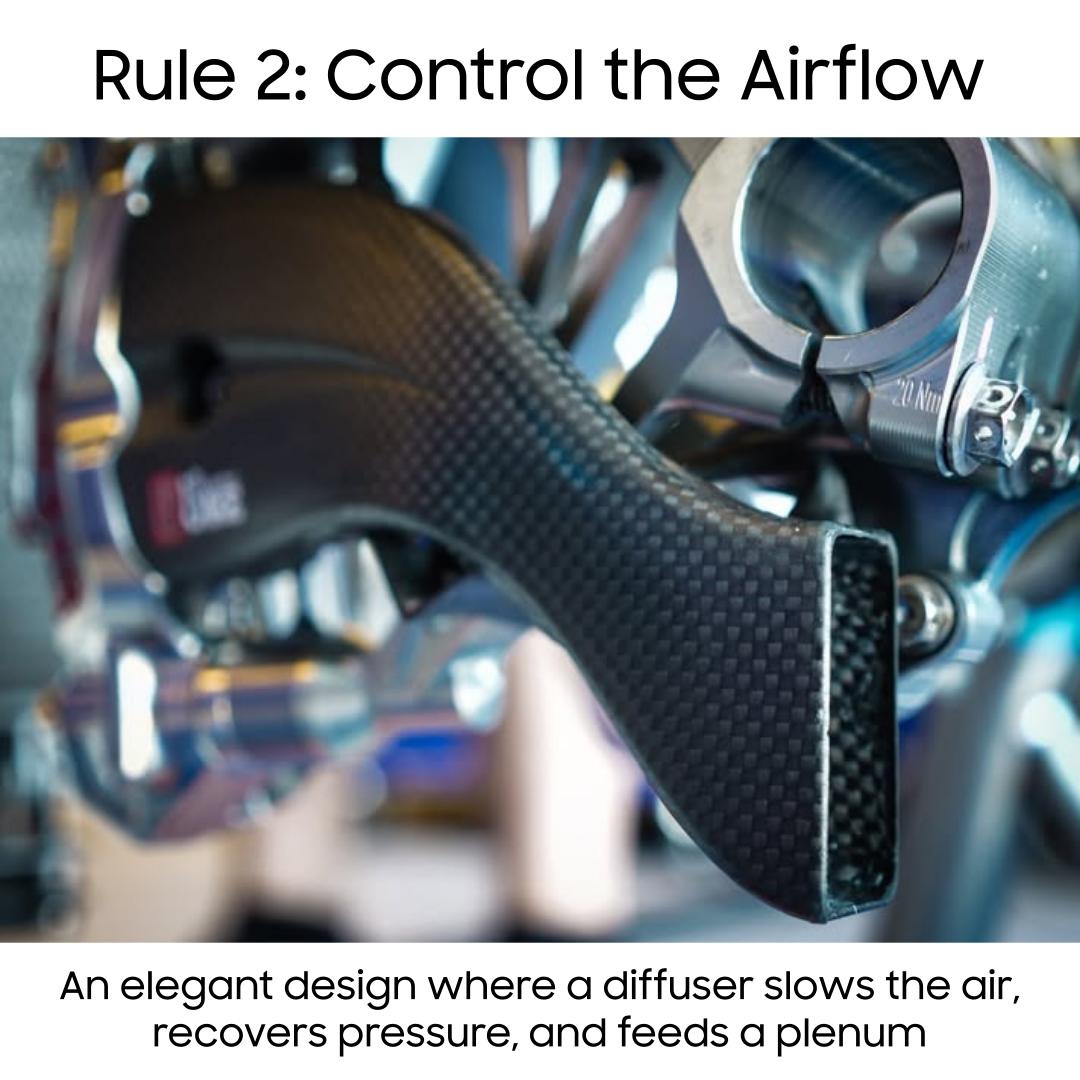
The role of the duct is to convert dynamic pressure (velocity) from the free stream into static pressure at the cooling interface. This is achieved using a diffuser: a gradually expanding duct that slows the flow and recovers pressure.
A plenum at the end of the duct does not act as a heat exchanger – similar to an airbox. Instead, it stabilises pressure, equalises flow distribution, and reduces sensitivity to steering angle, fork movement, and external disturbances.
Higher static pressure allows airflow to be maintained through leakage paths and against pumping effects. This results in more uniform cooling and, critically, more consistent brake pad temperatures.
Benchmark MotoGP designs consistently terminate in a plenum before the brake disc or caliper, reflecting this pressure-based approach.
Rule 3 — Flow must remain attached through the duct
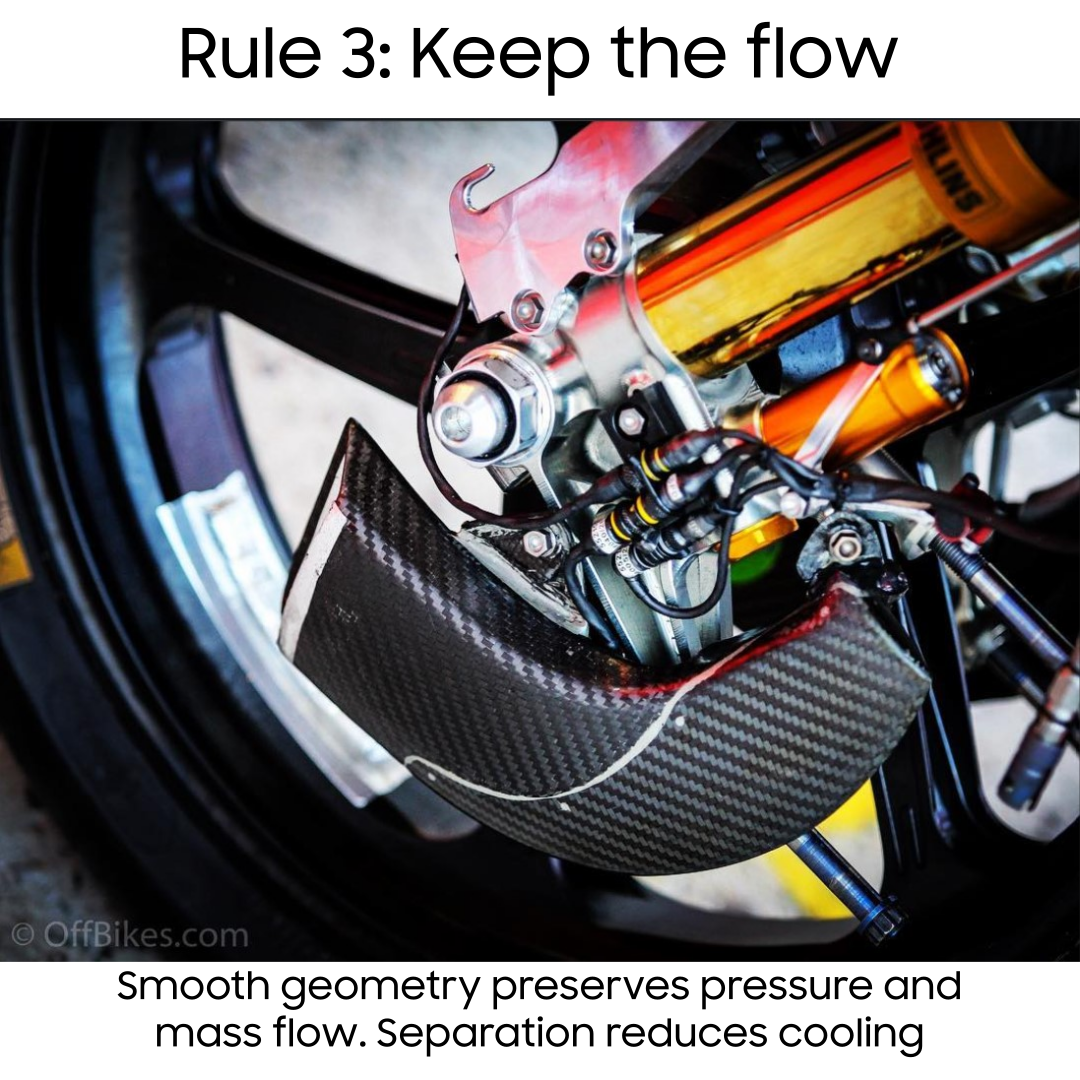
For a diffuser and plenum to function correctly, flow must remain attached along the internal surfaces of the duct.
Flow separation thickens the boundary layer, reduces momentum, and causes pressure losses that directly reduce usable mass flow. Separated flow also lowers convective heat transfer at the disc surface, even if inlet velocity is high.
Shallow expansion angles and smooth internal curvature preserve boundary-layer attachment and maintain diffuser efficiency. Sudden expansions, contractions, or sharp turns create recirculation zones that waste pressure and can form local thermal hot spots.
Effective brake ducts prioritise flow quality and pressure recovery over aggressive or visually dramatic shapes.
Brake duct design today is no longer about chasing maximum airflow. It’s about controlling temperature so brake feel remains predictable as conditions change.
The physics is straightforward. Clean inlet air matters more than size. Pressure recovery matters more than velocity. Attached flow matters more than aggressive shapes. Designs that follow these principles tend to be smaller, more integrated, and less obvious.
The next time you look at a brake duct, evaluate it through this lens. Ask where the air comes from. Ask how pressure is managed. Ask whether the geometry preserves flow quality all the way to the brake.
Once you know what to look for, good design becomes hard to miss.